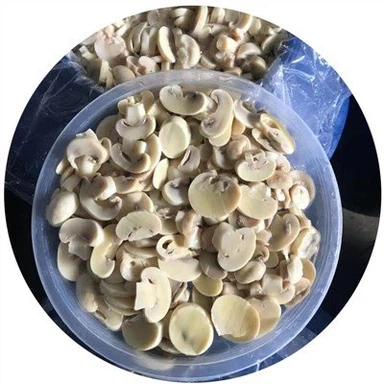

How to process brine mushrooms?
Aug 30, 2021
1. Color protection. The purchasing department will immediately use sodium metabisulfite solution (20 grams of sodium metabisulfite in 100 kilograms of water, each solution can be used for 5 times and then replace) immediately after purchasing fresh mushrooms. Soak in five ten-thousandths of sodium metabisulfite solution (50 grams of sodium metabisulfite in 100 kg of water, after 5 times of use, it can be used for the first cleaning of mud debris), soak for 10 minutes and take it out to make the mushroom body white, then Rinse with clean water;
2. Rinse. Fresh mushrooms that have been treated with color protection should be rinsed in running water for 3-4 times immediately to rinse the residual liquid of sodium metabisulfite;
3. Pre-cooking. In order to prevent mushrooms from opening and to ensure quality, we must hurry up and cook mushrooms. The salt water concentration of boiling mushrooms is 50 kg of water and 2.5-3.5 kg of salt, dissolved and boiled. The rinsed mushrooms are placed in a bamboo basket, the filling amount is about three-fifths of the volume of the bamboo basket, and then placed in a pot in salt water. Timing after the water is boiling, the small mushrooms will cook for about 7-8 minutes, and the big mushrooms for about 10 minutes (depending on whether the center of the mushroom is cooked). Then take out the mushroom basket and put it in cold water to cool. During the cooking process, use the grab fence to turn up and down to make the mushrooms evenly mature. This salt water can be used continuously for 5-6 times. But after the third use, add 3% salt or brine to increase the saltiness, but do not use too many times, otherwise the color of the mushrooms will turn black;
4. Cool down. The pre-cooked mushrooms are immediately cooled in flowing clean water. Generally, 4 to 5 cold water tanks are used for continuous cooling. If possible, they can be cooled in an automatic water tank, and the mushrooms can be turned up and down with a tool to cool the mushrooms evenly;
5. Classification. The grading is based on the diameter of the surface of the cooked mushrooms. Level 1: Mushroom surface diameter is less than 1.5cm; Level II: Mushroom surface diameter is 1.5-2.5cm; Level 3: Mushroom surface diameter is 2.5-3.5cm; Level 4: Mushroom surface diameter is more than 3.5cm.
The classification is generally sieved with a classifier. In sieving, flushing with tap water can also play a cooling role. After grading, pour the various mushrooms on the table, and manually pick up the deformities, thin skins, stalks, damaged mushrooms and mushroom stalks;
6. Brine immersion. First, the graded mushrooms are weighed and recorded so that the required amount of brine and salt can be calculated by weight. The amount of brine is calculated at 60% of the weight of the pre-cooked mushrooms. The salinity is 22-24 degrees Baume. (Add 20 kilograms of salt to 50 kilograms of cold water and stir until it melts. Determine the salinity to be between 22-24 degrees Baume. If the saltiness is insufficient, add some salt appropriately. , To reach. Then precipitation, remove impurities Serve.) And then add 10% refined white salt. Then put the mushrooms in the brine, and after soaking for 48 hours, the saltiness stabilizes at 15-16 degrees Baume. After taking it out, immerse it in a new brine of Baume 22°C (without adding 10% salt) for 48 hours. At this time, the saltiness should be between Baume 15-16°C. If the saltiness is not enough, the saltiness can be adjusted appropriately on the brine when filling the barrel. If the mushroom brine is 15-16 degrees in Baume, the brine should be 22 degrees in Baume; the brine for mushroom soaking is around 18 degrees in Baume, and the brine is 20 degrees during barreling; the brine for mushroom soaking is less than 15-16 degrees in Baume. Degree, the brine should be appropriately increased in saltiness on the basis of Baume’s 22 degrees when filling barrels;
7. Bucket. Brine mushrooms generally use 25 kg or 50 kg plastic buckets, which are convenient for calculation and transportation.
Before filling the barrels, the mushrooms are categorized and weighed in baskets, and the brine is broken (the brine is not dripping in a line) as the standard. The net weight of each barrel of mushrooms is 25 kg or 50 kg. It should be strictly controlled so that the error does not exceed ±1%.
When loading mushrooms, first add about 3 kg of salty brine in the bucket (the brine used for the bucket is 50 kg of water and 20 kg of salt, after boiling and melting, determine the saltiness between 22-24 degrees Baume, cooling and precipitation After filtering with gauze, add 0.2% citric acid to dissolve and serve), make the loaded mushrooms float on the brine without pressure loss, and then put the weighed mushrooms into the bucket, and then fill the brine, (usually in half Within months, check for dehalogenation frequently to prevent dehalogenation from deteriorating mushrooms). It is best to install it in a bucket with an inner lid, and the inner lid has holes to press the mushrooms in the brine, and the brine is covered with no mushrooms to ensure the quality. The processed brine mushrooms require clear classification, complete mushroom shape, white mushroom surface, no open umbrella, no thin skin and large deformed mushrooms, brine salinity above 20 degrees, clear brine, bright yellow color, and no impurities.